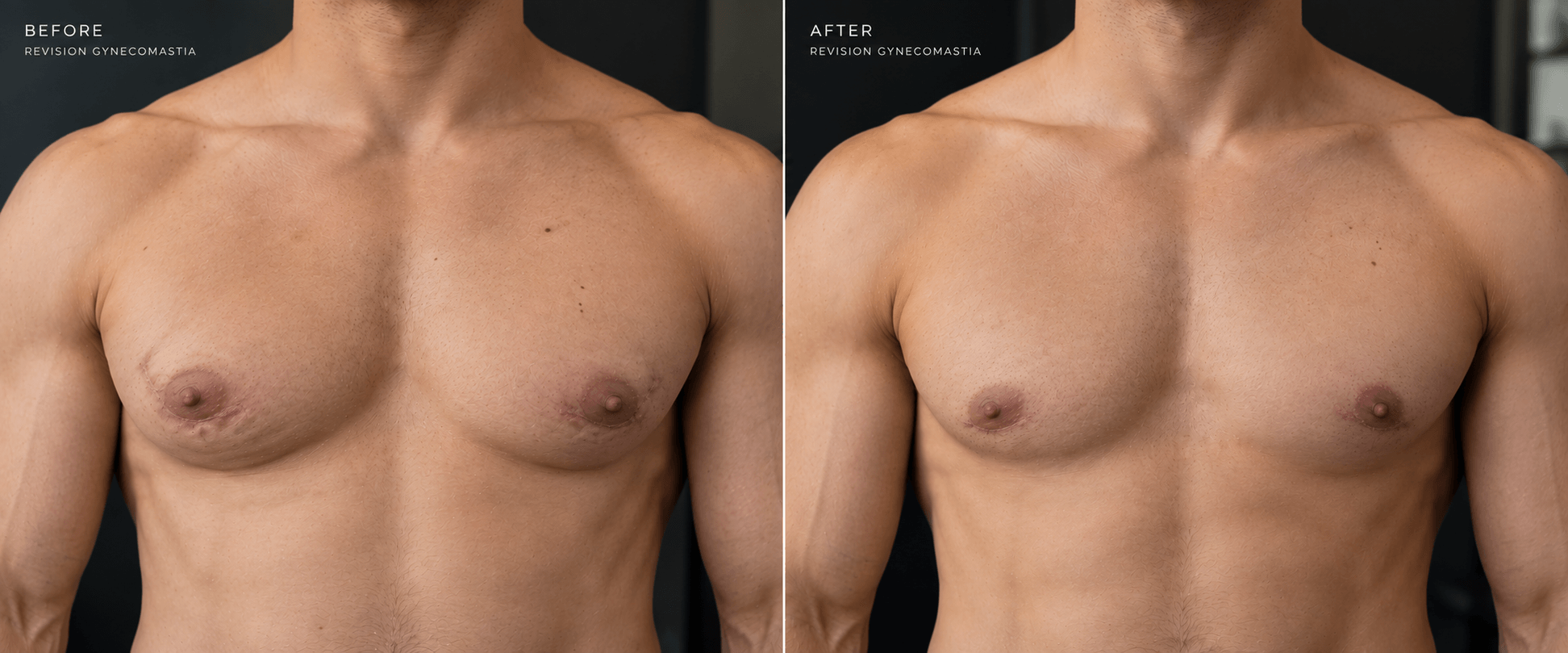
You Already Had Gynecomastia Surgery. Something Still Isn’t Right.
Revision surgery starts by identifying exactly why the first result is bothering you.
Maybe gland was left behind. Maybe too much tissue was removed beneath the nipple. One side may look different from the other. The chest may appear wavy, hollow, tethered or irregular. Or the original surgery may simply have failed to create the male chest contour you expected.
Dr. Jonathan Lebowitz evaluates the original anatomy, what was previously removed, the scar tissue that has developed and what tissue remains available to work with before determining whether revision can meaningfully improve the chest.
Dr. Lebowitz Is Not Starting With Untouched Anatomy
Primary gynecomastia surgery involves tissue that has not previously been surgically altered. Revision surgery is different.
Previous excision or liposuction may have removed tissue unevenly, changed the blood supply, created internal scar tissue or altered the relationship between the skin, nipple and pectoral muscle.
That means the revision plan cannot simply repeat the first operation. Dr. Lebowitz must first understand what is missing, what remains and what has become tethered or distorted.
First Diagnose the Problem. Then Choose the Technique.
A revision procedure should not begin with “more liposuction” or “remove more gland.” It should begin with understanding why the chest looks the way it does.
Too much gland or fat may remain, leaving the chest incompletely reduced or the nipple still projected.
Too much tissue may have been removed, producing a depression or crater beneath the nipple.
Internal fibrosis can pull the nipple, skin or surrounding tissue inward and create an irregular surface.
Loose or poorly re-draped skin may remain after substantial volume reduction.
The two sides may differ in volume, nipple position, contour, scarring or muscular transition.
Many revision patients have more than one issue that must be addressed as part of the same plan.
Revision surgery is highly individualized. Two patients who both dislike their original result may require completely different corrective procedures.
Residual Gland or Chest Fullness
Some patients seek revision because the original surgery did not sufficiently reduce the tissue responsible for the gynecomastia.
A firm gland may remain beneath the nipple, excess fat may persist across the chest or both may be present. The nipple may still appear puffy even though part of the original breast tissue was removed.
Dr. Lebowitz evaluates whether the remaining fullness is gland, fat or a combination before deciding how to approach it.
Crater or Saucer Deformity
Sometimes the problem is not remaining tissue. It is tissue that is no longer there.
If too much support was removed directly beneath the nipple and areola during the original surgery, the center of the chest can collapse inward and create a visible depression.
The nipple may appear stuck down to the underlying pectoral muscle, particularly when the arms move or the chest is flexed. This is often referred to as a crater or saucer deformity.
Correcting a crater generally requires a different strategy than treating residual gynecomastia. Simply removing additional tissue would make the deficit worse.
Sometimes Revision Means Adding — Not Removing
When the previous operation has left a meaningful tissue deficit, Dr. Lebowitz may need to restore volume beneath or around the nipple rather than remove more.
Depending on the anatomy, scar pattern and available donor tissue, techniques such as scar release and strategic fat grafting may be considered to improve a depressed or irregular contour.
Fat grafting is not a perfect filler and not all transferred fat survives. The amount retained can vary, and some cases may require staged refinement.
Contour Irregularities, Rippling & Asymmetry
A chest can be technically smaller after surgery and still look wrong because the remaining tissue does not transition smoothly.
High & Low Areas
Uneven fat removal can leave visible transitions between fuller and thinner areas of the chest.
Left-to-Right Differences
Residual gland, fat, skin and scar tissue may differ between sides and exaggerate natural asymmetry.
Rippling or Waviness
Thin soft-tissue coverage or internal scar tissue can make the chest surface appear irregular.
Dynamic Distortion
A contour may look acceptable while relaxed but become tethered or irregular when the arms move or the pec contracts.
The Nipple Can Tell You a Lot About What Happened Underneath
Previous gynecomastia surgery can alter the support beneath the nipple-areola complex. A nipple may remain puffy because gland was left behind, or it may become depressed because too much tissue was removed.
Scar contraction can also pull the nipple inward or distort the areolar border.
Dr. Lebowitz therefore evaluates the nipple as part of the entire revision — not as an isolated surface feature.
Unfavorable Scarring May Be Part of the Revision
Some patients are satisfied with the amount of breast reduction but unhappy with visible, widened, raised, indented or poorly positioned scars from the original procedure.
Whether a scar can be revised depends on its location, maturity, surrounding tissue and the reason it healed the way it did.
Scar revision replaces one scar with another — it does not erase the fact that surgery occurred. The objective is to create a more favorable scar where the anatomy allows.
Removing Volume Does Not Automatically Tighten the Skin
Men with long-standing gynecomastia, significant previous enlargement, major weight loss or reduced skin elasticity may be left with redundant skin after the original procedure.
Dr. Lebowitz evaluates whether the skin may continue to improve with time, whether additional contouring could help, whether adjunctive skin-tightening technology such as Renuvion may have a role, or whether direct skin removal needs to be discussed.
More significant skin excision can mean longer scars, so the trade-off between contour improvement and scar length should be considered carefully.
Revision Should Not Be Rushed
A chest that looks imperfect early in recovery is not automatically a failed result.
Swelling, firmness, scar contraction, numbness and tissue position can continue changing for months after gynecomastia surgery. In many situations, Dr. Lebowitz needs to see how far the original result will settle before determining which problems are truly permanent and which are still part of healing.
When revision is elective, allowing sufficient healing and scar maturation can make the anatomy easier to evaluate and the corrective plan more predictable. The appropriate timing depends on the previous operation and the problem being addressed.
Bring Information From Your First Surgery if You Have It
Understanding exactly what was performed can help Dr. Lebowitz evaluate a revision. If available, bring or provide information such as your operative report, previous before-and-after photographs and details about your postoperative course.
Operative Report
Can help clarify what techniques were used and what tissue was reportedly removed.
Pre-Surgery Photos
Show what your anatomy looked like before the original procedure.
Recovery History
Hematoma, seroma, infection, wound problems or unusual scar formation may be relevant.
Do not delay requesting a consultation just because you do not have these records. Dr. Lebowitz can still examine the chest and discuss what can be determined from the anatomy in front of him.
The Technique Depends on the Defect
A revision may involve removing tissue, adding tissue, releasing scar, tightening skin or combining several approaches.
Residual Gland Excision
Additional glandular tissue may be removed when persistent central fullness or nipple projection remains.
VASER 4D Hi-Def
Where residual or uneven fatty tissue is present, VASER may be considered to refine appropriate areas of the surrounding contour.
Scar Tissue Release
Internal adhesions may need to be released when skin or nipple tissue is tethered to deeper structures.
Fat Grafting
Strategic fat transfer may be considered when previous surgery has left a contour deficit that needs additional volume.
Skin Management
Renuvion or direct skin-removal techniques may be considered where skin laxity is contributing to the problem.
Scar or Nipple Revision
Visible scars or nipple distortion may require focused correction as part of the larger chest plan.
Seeing the Chest Move Can Reveal Problems You Cannot See Lying Still
Scar tethering and contour defects can change dramatically when the arms move or the pectoral muscles contract.
Dr. Lebowitz performs many appropriately selected gynecomastia and male body-contouring procedures under local anesthesia in his private surgical setting in Huntington, New York.
When a revision procedure is appropriate for local anesthesia and the patient remains responsive, Dr. Lebowitz can ask him to raise his arms, change position, twist, flex the chest and contract the pectoral muscles while the contour is being reassessed.
This can be particularly useful in revision surgery because a depression, adhesion or asymmetry may become more or less obvious depending on how the chest moves.
Revision procedures vary substantially in complexity. Local anesthesia is not appropriate for every revision, and Dr. Lebowitz determines the anesthetic and surgical approach after evaluating the individual case.
The Goal Is Meaningful Improvement — Not a Promise of Perfection
Revision surgery has limitations that primary surgery may not have.
Previous tissue removal, existing scars, skin quality, altered blood supply and the amount of healthy tissue still available all influence what can realistically be changed.
Dr. Lebowitz evaluates whether the problem can be improved enough to justify another operation and explains the trade-offs before proceeding.
Sometimes the Right Revision Plan Is to Wait.
Not every lump, firm area or asymmetry seen during early recovery should immediately be surgically corrected.
Dr. Lebowitz may determine that additional healing, scar maturation, compression, massage or another individualized postoperative measure should occur before another operation is considered.
The important question is not simply whether something looks imperfect today. It is whether the finding represents a mature structural problem that another procedure can reasonably improve.
Look for Patients With the Same Kind of Problem — Not Just the Same Diagnosis
Revision cases can be very different from one another. A patient with residual gland does not need the same operation as a patient with a crater deformity, scar tethering or significant loose skin.
When reviewing results, look for cases where the starting defect resembles yours. That comparison is generally more useful than looking at primary gynecomastia transformations.
Recovery Depends on What Had to Be Corrected
There is no single revision-recovery timeline because the operation can range from focused scar release to a more extensive reconstruction involving excision, contouring, fat grafting or skin treatment.
Compression
Dr. Lebowitz may recommend compression depending on the procedures performed and the tissues being treated.
Swelling & Scar Tissue
Revision tissues can again become swollen and firm. Early irregularity should not automatically be interpreted as the final result.
Activity
Return to work, lifting and exercise depends on the extent of the revision and the physical demands of your daily routine.
Ongoing Evaluation
Dr. Lebowitz follows how the reconstructed or revised chest changes as swelling resolves and scar tissue matures.
Revision Gynecomastia Surgery FAQs
Can gynecomastia surgery performed by another surgeon be corrected?
Many problems after previous gynecomastia surgery can potentially be improved, but the possibilities depend on what caused the unsatisfactory contour and how much healthy tissue remains. Dr. Lebowitz must examine the chest before determining what is realistically correctable.
What are the most common reasons men seek revision surgery?
Common concerns include residual gland or fat, crater or saucer deformity from excessive tissue removal, contour irregularity, asymmetry, scar tethering, loose skin, nipple distortion and unfavorable scars. More than one problem may be present at the same time.
What is a crater deformity after gynecomastia surgery?
A crater deformity is a depression that can occur when too much supporting tissue is removed beneath the nipple and areola. Scar tissue may also tether the skin downward toward the underlying pectoral muscle, making the depression more visible.
Can a crater deformity be filled with fat?
Strategic fat grafting may be considered in selected patients when previous surgery has left a volume deficit. Scar tissue may also need to be released. Fat survival is variable, so the amount of correction and whether staged treatment could be necessary should be discussed individually.
Can residual gland be removed during revision surgery?
Yes, when residual gland is responsible for persistent projection and it can be safely addressed. The revision must account for previous scars, tissue removal and the amount of support remaining beneath the nipple.
How long should I wait before considering a revision?
The appropriate timing depends on the previous procedure and the problem being considered. Swelling, firmness, skin re-draping and scar tissue can continue changing for months, so elective revision is often not planned until the original result has had sufficient time to mature. Dr. Lebowitz can evaluate where you are in the healing process.
Can revision gynecomastia surgery be performed under local anesthesia?
Some appropriately selected revision procedures can be performed under local anesthesia. More complex revisions may require a different anesthetic plan. Dr. Lebowitz determines this after evaluating the extent of reconstruction or contouring required.
Can revision surgery make my chest perfect?
No surgeon can promise a perfect chest, particularly after previous surgery has altered the tissues. The objective is meaningful improvement within the limitations of the remaining anatomy, scars, skin and blood supply. Dr. Lebowitz discusses those limitations before recommending another operation.
You Can Begin the Revision Evaluation From Wherever You Live
Men seeking revision frequently travel to Dr. Lebowitz after undergoing their original procedure elsewhere. Out-of-town patients can begin with a virtual consultation and share photographs and available surgical information before planning travel to Huntington, New York.
Get a Fresh Evaluation of Your Chest.
If you are unhappy with the result of previous gynecomastia surgery, Dr. Lebowitz can evaluate the residual tissue, depressions, scar tissue, skin, nipples and overall chest contour and discuss what he believes can realistically be improved.