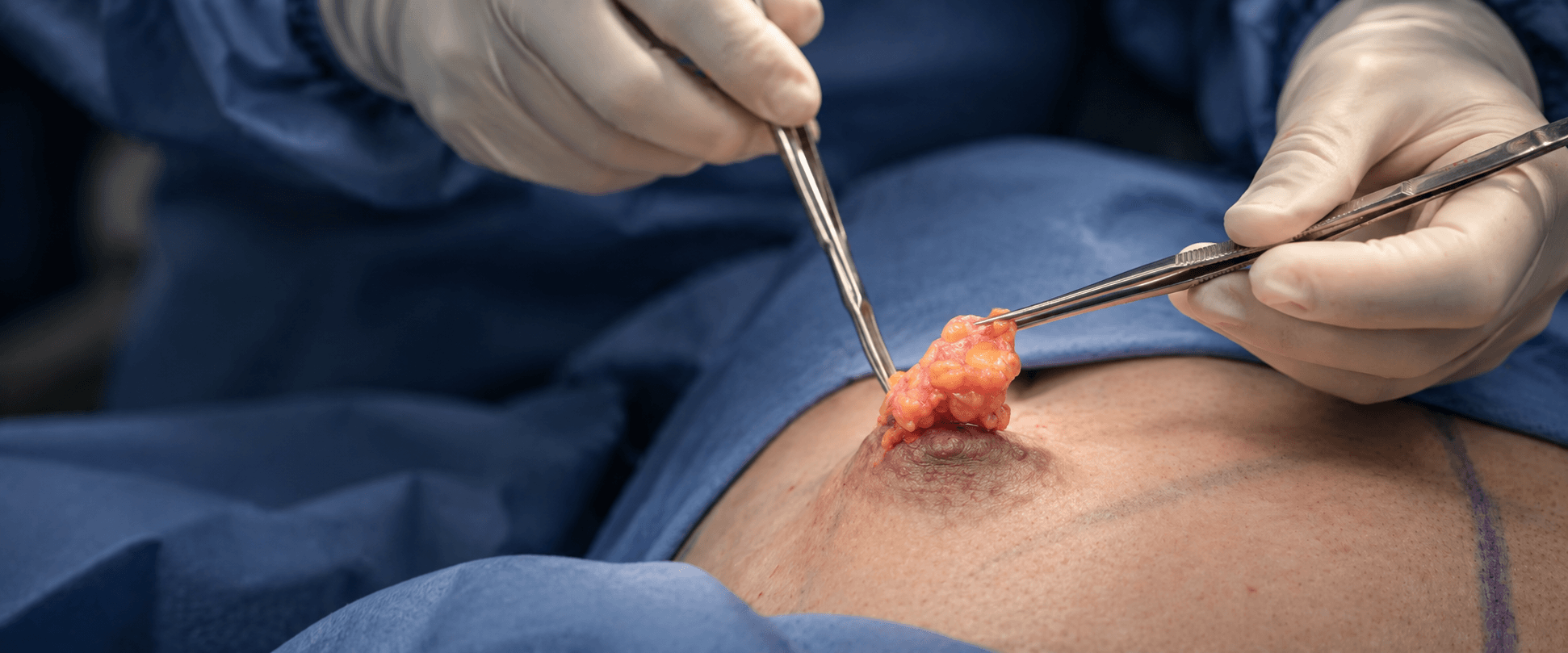
When the Problem Is Gland, Fat Removal Alone Isn’t the Answer
Gynecomastia gland is different from ordinary chest fat.
It can feel firm, dense or rubbery beneath the nipple and areola, creating projection that remains even after weight loss, dieting and hours in the gym. For some men, that gland is the primary reason the nipple stays puffy or the chest still looks rounded despite an otherwise lean physique.
Dr. Jonathan Lebowitz evaluates how much of your chest contour comes from gland, fat, skin and the underlying pectoral anatomy. When dense glandular tissue is creating the problem, direct surgical excision may be necessary to address it.
Gland and Fat Are Not the Same Tissue
This distinction is one of the most important parts of gynecomastia treatment. Fat can often be reduced with liposculpting. A dense gland beneath the nipple behaves differently and may require direct removal.
That is why a man can lose substantial weight, become extremely lean or build a well-developed chest and still have a nipple that projects forward.
Dense Breast Gland May Need to Be Removed Directly
If a firm gland is creating the projection, simply treating the surrounding fat may leave the central problem behind.
Direct excision allows Dr. Lebowitz to access the glandular tissue beneath the nipple and separate the unwanted tissue from the surrounding structures while evaluating how the nipple-areola complex is settling over the chest.
Determine where the gland begins and how it relates to the surrounding fat and muscle.
Access the gland through an incision positioned according to the individual anatomy.
Remove the glandular tissue contributing to unwanted projection.
Blend the surrounding tissues so the treated area transitions naturally into the male chest.
The objective is not indiscriminate removal. Taking too much tissue beneath the nipple can contribute to an unnatural depression or crater deformity. Dr. Lebowitz balances reduction of the gland with preservation of an appropriate contour beneath the nipple and areola.
“Where the Water Meets the Beach.”
That is how Dr. Lebowitz has described the natural transition along the border of the areola.
When direct gland excision is necessary, an incision can often be positioned along a portion of this color transition. The change between the pigmented areola and surrounding chest skin can help the incision blend as the scar matures.
No surgical scar is invisible, and scar appearance varies from person to person. Genetics, skin type, healing, sun exposure and postoperative scar care can all affect the final appearance.
Puffy Nipples Can Be a Gland Problem
Some men do not have a visibly large chest. Instead, the chest looks relatively lean until the nipple and areola project outward in a rounded or dome-shaped contour.
A concentrated gland directly beneath the nipple can push the nipple-areola complex forward. In these cases, additional dieting or chest exercise may do very little because the problem is not simply excess body fat.
Dr. Lebowitz evaluates the amount of gland and the surrounding chest contour together so treatment addresses both the central projection and the transition into the rest of the chest.
What if You Have Gland and Chest Fat?
The original version of this page correctly emphasized that many men have both dense glandular tissue and excess fat. That distinction remains important — but the current contouring technology Dr. Lebowitz uses is VASER 4D Hi-Def rather than the older Laser Smart Lipo terminology previously featured on the page.
Focused Gland Removal
A lean man with a concentrated gland and minimal surrounding fat may primarily require direct excision and careful blending around the nipple.
Excision + VASER
When gland and excess chest fat are both contributing, Dr. Lebowitz may combine direct gland removal with VASER 4D Hi-Def sculpting.
Broader Male Contouring
For some men, the chest looks best when Dr. Lebowitz also considers the lateral chest, abdomen, flanks or other surrounding areas as part of one body-contouring plan.
VASER 4D Hi-Def Helps Sculpt Around the Gland
VASER uses ultrasound-assisted technology to help address fatty tissue. It does not make direct gland excision unnecessary when a dense gland is present.
Instead, Dr. Lebowitz can use VASER where appropriate to refine the surrounding chest, expose muscular transitions and blend the gland-removal area into the pectoral and torso contour.
The combination is particularly important when the objective is not merely breast reduction, but a more defined male chest.
Gland Removal Under Local Anesthesia
For appropriately selected patients, Dr. Lebowitz performs gynecomastia gland removal with the patient awake under local anesthesia in his private surgical setting in Huntington, New York.
For Dr. Lebowitz, being awake can also contribute to the way he evaluates the chest. Because you remain responsive, he can ask you to reposition your arms, turn, flex your chest and contract the pectoral muscles as he reassesses the developing contour.
This is particularly useful when gland has been removed from directly over the pectoral muscle. Dr. Lebowitz can examine how the nipple, remaining tissue and muscular anatomy interact in more than one position as he works.
Local anesthesia is not appropriate for every patient or every surgical plan. Dr. Lebowitz determines the anesthetic approach after evaluating your health, anatomy and the extent of treatment being considered.
More Is Not Automatically Better
The objective is a better contour — not simply the largest possible specimen.
The gland sits immediately beneath the nipple-areola complex. Removing inadequate tissue can leave residual projection, while overly aggressive removal can leave a depression, tethering or an unnatural transition.
Dr. Lebowitz evaluates how much tissue needs to be removed for that individual chest while continually considering the nipple, skin, surrounding fat and pectoral anatomy.
Different Patients Can Have the Same Underlying Problem
Dense glandular tissue can appear in very different male physiques.
Adult Men
Some men have carried glandular tissue since puberty and finally decide to address it years or decades later.
Bodybuilders
In a very lean muscular chest, even a relatively small gland can project prominently over a developed pectoral muscle.
Men With Puffy Nipples
The primary concern may be nipple and areolar projection rather than generalized enlargement of the entire chest.
Don’t Just Look at How Much Tissue Came Out. Look at the Chest.
Large gland specimens can be dramatic to see, but the removed tissue is not the final result. What matters is how the nipple and surrounding chest look after the gland is gone and the tissues have healed.
When reviewing Dr. Lebowitz’s results, look for patients whose starting anatomy resembles yours and examine the transition across the nipple, areola and pectoral contour.
Recovery & Healing
The original page discussed compression, activity and returning to the gym. Those remain important topics, but the timeline should be based on the individual procedure rather than a universal number of days.
Compression
Dr. Lebowitz may prescribe a compression garment to support the treated chest and help manage swelling during early healing.
Swelling & Firmness
The area beneath the nipple may feel swollen, firm or different as tissues heal. The early postoperative chest should not be judged as the final result.
Activity & Exercise
Routine movement generally returns before heavy lifting and strenuous chest exercise. Dr. Lebowitz determines when you should advance activity.
Follow-Up
Dr. Lebowitz follows the healing process and adjusts postoperative instructions according to the operation and how your chest is responding.
Glandular Tissue Can Be Examined After Removal
When clinically appropriate, excised breast tissue may be submitted for pathologic examination, where it can be evaluated microscopically.
This is different from the way fatty tissue removed during liposuction is handled. Dr. Lebowitz can explain what will be done with excised tissue in your individual case.
Gynecomastia Gland Removal FAQs
Can liposuction remove the gynecomastia gland?
Liposuction is designed primarily to remove fatty tissue. Dense glandular tissue beneath the nipple may not respond adequately to liposuction alone and can require direct excision. Dr. Lebowitz determines how much gland and fat are present during his evaluation.
Will gland removal fix puffy nipples?
If glandular tissue beneath the nipple is causing the projection, removing that tissue can address an important component of the puffiness. The final contour also depends on the areola, surrounding tissue, skin quality and healing.
Where is the gland-removal scar?
When direct excision is required, an incision may be positioned along a portion of the border between the pigmented areola and surrounding chest skin. Scar appearance varies among patients and continues to evolve during healing.
Do you remove every bit of breast gland?
The surgical objective is not simply to remove the maximum possible amount of tissue. Dr. Lebowitz removes the tissue necessary to address the unwanted projection while preserving an appropriate contour beneath the nipple. Excessive central removal can create an unnatural depression.
Do I also need VASER liposculpting?
Not necessarily. A lean patient with a localized gland may primarily require excision. When chest fat or surrounding torso contour also contributes to the appearance, Dr. Lebowitz may incorporate VASER 4D Hi-Def into the surgical plan.
Can glandular gynecomastia come back?
The tissue physically removed during surgery is removed, but the body can still change. Remaining breast tissue may respond to future hormonal changes, certain medications or anabolic steroid use, and significant weight changes can alter the fatty component of the chest.
Will I need drains?
Not every gland-removal procedure requires a drain. Whether one is appropriate depends on the extent of surgery, the tissue removed and the individual patient’s anatomy and healing considerations. Dr. Lebowitz determines this as part of the surgical plan.
Patients Come to Huntington, Long Island, NY From Across the U.S. and Abroad
If you do not live on Long Island, you can begin with a virtual consultation before deciding whether to travel to Dr. Lebowitz’s Huntington, New York practice.
Start With the Anatomy Beneath Your Nipple.
If firm glandular tissue is creating puffy nipples or an enlarged male chest, Dr. Lebowitz can evaluate how much of the contour comes from gland, fat and surrounding tissue and discuss the treatment approach he would consider for you.