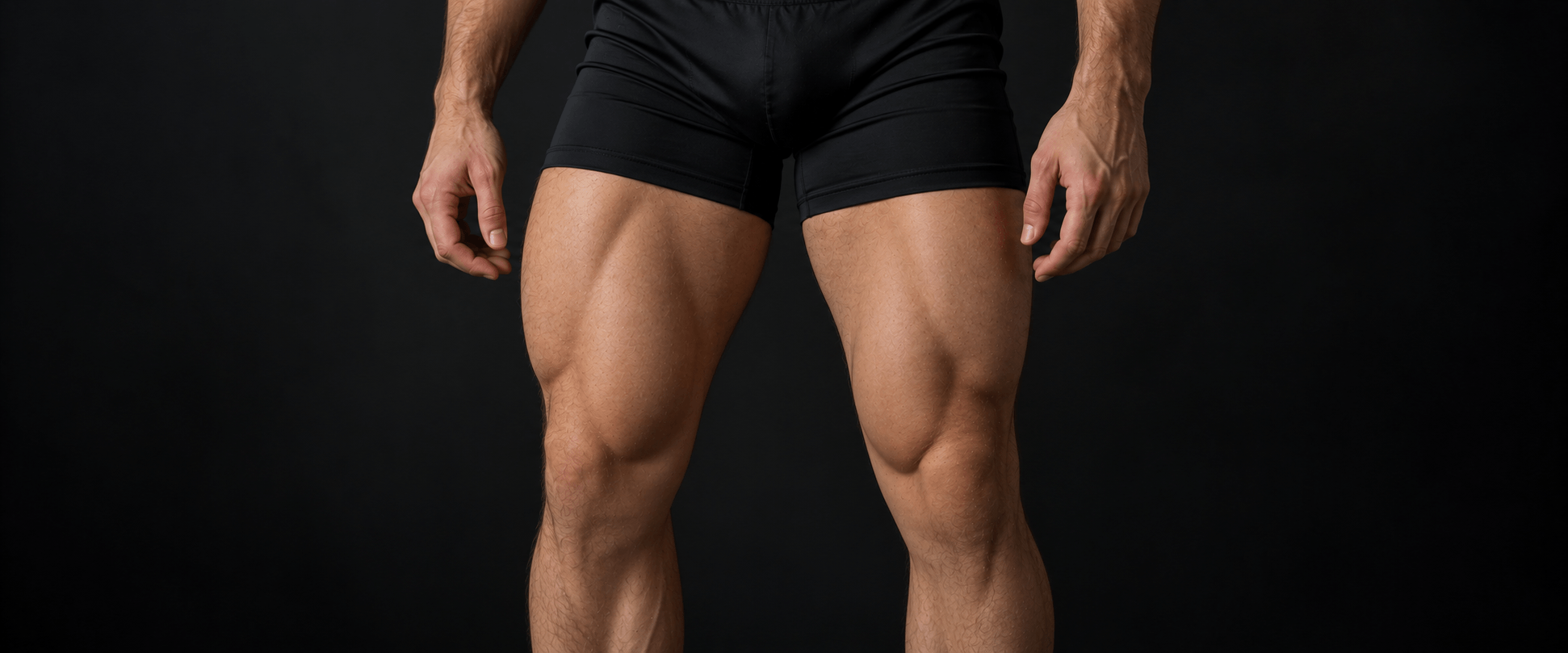
Your Thighs Don’t Have to Match Where the Rest of Your Body Stores Fat.
You can become leaner through the waist, arms and upper body while stubborn fullness remains through the inner or outer thighs.
Fat distribution is individual. For some patients, the thighs remain disproportionately full despite otherwise stable weight and consistent exercise.
Dr. Jonathan Lebowitz uses VASER 4D Hi-Def liposuction in appropriately selected patients to reduce localized subcutaneous thigh fat while preserving the shape of the leg and the transitions into the hips and knees.
“My Thighs Are Too Big” Isn’t Specific Enough to Build a Surgical Plan.
The thigh wraps around the femur and contains very different anterior, medial, lateral and posterior contours.
Dr. Lebowitz determines where unwanted subcutaneous fat is actually located before deciding where treatment belongs.
Inner Thigh
Fullness along the medial thigh can affect the space between the legs and the transition toward the knee.
Outer Thigh
Localized “saddlebag” fullness can project laterally beneath the hip and widen the lower-body silhouette.
Front of Thigh
Anterior fullness must be assessed carefully because the quadriceps create important natural shape beneath it.
Posterior Thigh
The back of the thigh connects directly into the gluteal region and requires attention to that transition.
Fat, Cellulite, Loose Skin and Leg Shape Are Not the Same Thing.
Not every concern involving the thighs can be corrected by removing fat.
Dr. Lebowitz separates the volume problem from the skin-surface problem and from the anatomy that liposuction cannot change.
When the Inside of the Thigh Doesn’t Match the Rest of the Leg.
The medial thigh is one of the most common reasons patients ask about thigh liposuction.
Localized fat can create disproportionate fullness along the inner leg even when the surrounding body has become leaner.
In selected patients, reducing that layer can create a cleaner transition through the medial thigh and toward the knee.
Less Inner-Thigh Fat Does Not Guarantee a Gap Between the Legs.
Some patients specifically want to reduce contact or rubbing between the inner thighs. When excess removable fat contributes to that contact, reducing it may change how the thighs meet.
But whether the legs naturally separate is also affected by pelvic width, femur position, muscle development and overall skeletal anatomy.
Dr. Lebowitz therefore does not treat an artificial “thigh gap” as the surgical target. The goal is to improve the contour that your underlying anatomy can realistically support.
If thigh rubbing is caused partly by removable fat, contouring may reduce contact, but no particular amount of separation can be guaranteed.
The Outer Thigh Changes the Silhouette From Hip to Knee.
Localized lateral-thigh fat can create a convex bulge beneath the hip commonly described as a “saddlebag.”
This can make the lower body appear wider and can create a disproportion between the waist, hips and legs.
Dr. Lebowitz evaluates the outer thigh as part of the entire lateral silhouette rather than simply flattening the most prominent point.
Sometimes the Change Comes From Proportion — Not From Adding Anything.
The outer and posterior thighs sit directly below the gluteal region. Changing excess fullness around that transition can alter how the buttock appears in proportion to the leg.
That does not mean thigh liposuction automatically lifts, enlarges or reshapes the buttock itself.
It means that reducing a disproportionately prominent outer or upper thigh can sometimes allow the existing hip and gluteal contour to read differently.
Reduce the Fatty Layer Without Erasing the Shape of the Leg.
Thigh contouring is not simply circumferential debulking.
VASER uses ultrasound energy within selected subcutaneous fatty tissue to assist with fragmentation and emulsification before aspiration.
Dr. Lebowitz then determines how much tissue should be reduced in each area while preserving the natural curves and changes in thickness that belong in a human leg.
Map
Identify where unwanted fat begins and how it connects to adjacent areas.
Prepare
Infiltrate the treatment zone and use VASER ultrasound within selected fatty tissue.
Reduce
Aspirate the amount of fat appropriate for that region and skin envelope.
Blend
Reassess the transition into the hip, knee and opposite side.
A Leg Can Look Lean From the Front and Still Look Heavy From the Side.
Thigh contour changes depending on the viewing angle.
A prominent outer thigh may be most obvious from the front or rear. Inner-thigh fullness changes the medial silhouette. Posterior fullness is better appreciated from the profile and three-quarter views.
Shows overall leg width and inner-thigh relationship.
Reveals anterior and posterior projection.
Shows the posterior thigh and connection to the gluteal region.
Often reveals outer-thigh transitions that disappear in straight views.
The Quadriceps, Hamstrings and Adductors Create the Shape Underneath.
The muscular anatomy of the thigh naturally produces changes in width and contour from the hip to the knee.
In athletic patients, selectively reducing an overlying fatty layer may allow more of that structure to become apparent.
In other patients, the objective may simply be a slimmer, smoother proportion rather than pronounced muscular definition.
Reposition the Leg. Rotate It. Tighten the Muscle. Check the Shape Again.
For many appropriately selected VASER procedures, Dr. Lebowitz uses local anesthesia while the patient remains responsive.
Depending on the treatment area and surgical setup, that can allow changes in leg position and muscle activation while he assesses the developing contour.
The relationship between the inner thigh, quadriceps, outer thigh and knee changes as the hip and leg move.
Dynamic reassessment can provide another perspective on whether the remaining fatty layer follows the anatomy naturally.
Local anesthesia and active patient participation are not appropriate for every patient or every extent of thigh surgery. Dr. Lebowitz determines the anesthetic plan individually.
Removing More Fat Can Make Loose Skin More Obvious.
The amount of removable fat is only one part of deciding how aggressively a thigh should be treated.
Skin elasticity varies with age, genetics, previous weight changes, stretch marks and baseline tissue quality.
Good Elasticity
Skin with useful tone may adapt more readily after appropriate volume reduction.
Mild Laxity
Dr. Lebowitz may consider an adjunctive treatment such as Renuvion when he believes it has an appropriate role.
More Loose Skin
Aggressive fat removal may expose rather than solve an inadequate skin envelope.
Substantial Excess
Direct skin-removal surgery may need to be discussed when laxity is the dominant problem.
One Reduces Fat. The Other Can Remove Excess Skin.
VASER liposuction is primarily a fat-contouring operation performed through small surgical access sites.
Thigh lift surgery is designed to remove redundant skin and reshape the soft-tissue envelope, often requiring a much longer incision.
Patients who have experienced substantial weight loss are particularly likely to need this distinction evaluated carefully.
Don’t Create a Leaner Thigh and Leave an Abrupt Pocket at the Bottom.
Inner-thigh fullness can continue down toward the medial knee, and lower-thigh fat can make the area directly above the knee appear heavy.
Dr. Lebowitz assesses that transition before determining where treatment should stop.
This does not mean every thigh patient requires knee liposuction. It means the knee should at least be evaluated before an artificial treatment border is chosen.
The Right Candidate Has a Fat-Distribution Problem That Surgery Can Meaningfully Change.
Dr. Lebowitz considers the location of the fat, overall body proportions, skin elasticity, muscular anatomy and expectations before recommending thigh liposuction.
Localized Thigh Fat
Persistent inner-, outer- or selected thigh fullness remains disproportionate to surrounding areas.
Reasonably Stable Weight
The goal is regional contouring rather than using liposuction as a substitute for major weight loss.
Suitable Skin
The skin can reasonably adapt to the proposed reduction or its limitations can be incorporated into the plan.
Realistic Leg Goals
You want a refined version of your own anatomy rather than a guaranteed thigh gap, specific circumference or someone else’s leg shape.
The Best Thigh Contour Usually Requires Leaving Some Fat Exactly Where It Belongs.
Natural legs contain curves and gradual transitions. Uniform over-thinning can remove those relationships.
Dr. Lebowitz considers both what should come out and what should remain so the leg retains soft-tissue coverage over moving muscle and transitions gradually toward untreated areas.
Follow the Leg From the Hip All the Way to the Knee.
Do not judge a thigh result from a tightly cropped photograph.
Compare the outer silhouette, inner-thigh line, knee transition and symmetry between both legs. Front, rear, side and three-quarter views each reveal different aspects of the contour.
Also separate improvements in shape from expectations about cellulite or skin texture, which are different concerns.
Your Legs May Feel Bigger Before They Begin Looking Smaller.
Postoperative swelling, bruising and firmness can temporarily obscure the reduction created during surgery. Recovery varies depending on how much of the thigh was treated and whether adjacent areas were included.
Walking & Instructions
Dr. Lebowitz provides individualized guidance for movement, incision care and any compression included in the postoperative plan.
Don’t Judge the Thigh Yet
The legs may temporarily look fuller or feel firmer while swelling and internal healing evolve.
Training Returns Gradually
Running, squats, lunges and strenuous lower-body workouts resume according to the extent of surgery and individual healing.
The Leg Line Develops
Thigh contour becomes easier to evaluate as swelling decreases and tissues continue softening and settling.
Smooth Leg Contours Depend on Surgery and Healing.
Potential complications of liposuction can include swelling, bruising, fluid accumulation, contour irregularity, asymmetry, sensory changes, scarring, infection, skin injury, blood clots and the possibility of additional treatment.
Ultrasound-assisted liposuction also carries the possibility of thermal injury.
Loose skin, cellulite and natural asymmetry may remain even after unwanted fat has been reduced. Dr. Lebowitz reviews the limitations and risks relevant to the specific treatment being considered.
VASER Thigh Liposuction FAQs
Can VASER make my thighs smaller?
VASER-assisted liposuction can reduce selected subcutaneous thigh fat when that tissue is contributing to unwanted size or disproportion. It does not reduce muscle or bone and is not intended to function as a significant weight-loss procedure.
Can VASER treat both the inner and outer thighs?
Potentially. Dr. Lebowitz evaluates the fat distribution throughout the leg and determines whether one region or multiple connected areas should be considered. Treating both is not automatically necessary.
Can inner-thigh liposuction give me a thigh gap?
No specific thigh gap can be promised because the space between the legs depends on pelvic width, skeletal alignment, muscle development and fat distribution. When removable inner-thigh fat contributes to contact between the legs, reducing it may alter the medial contour.
Can thigh liposuction help with rubbing or chafing?
If removable inner-thigh fat is contributing significantly to contact between the legs, reducing that volume may decrease how much the thighs touch. Other anatomical factors can also contribute, so complete elimination of rubbing cannot be guaranteed.
Does VASER remove cellulite?
Liposuction is designed to reduce subcutaneous fat, not eliminate cellulite. Cellulite is a skin-surface and connective-tissue issue and may remain after thigh contouring. Dr. Lebowitz evaluates fat volume separately from dimpling and skin texture.
Will VASER tighten loose thigh skin?
Skin may re-drape to varying degrees after volume is reduced, but significant loose skin should not be expected to disappear with liposuction. Dr. Lebowitz evaluates elasticity separately and may discuss Renuvion or a skin-removal procedure when appropriate.
What is the difference between thigh liposuction and a thigh lift?
Thigh liposuction primarily removes selected subcutaneous fat through small access sites. A thigh lift directly removes redundant skin and therefore involves substantially longer incisions. The correct operation depends on whether fat, skin or both are responsible for the unwanted contour.
Should my knees be treated too?
Not necessarily. Dr. Lebowitz assesses how the lower thigh transitions into the knee. If there is localized fat around the medial or upper knee that is disrupting that line, it can be discussed as part of the overall plan.
Can thigh VASER be performed under local anesthesia?
Dr. Lebowitz performs many appropriately selected VASER procedures under local anesthesia. The anesthetic plan depends on the patient’s health, the extent of thigh treatment and whether additional areas are being treated during the same procedure.
How long before my thighs look final?
The reduction occurs during surgery, but postoperative swelling and firmness can obscure the contour. The thighs continue changing as swelling resolves and tissues settle, and the timeline varies according to the amount and extent of treatment.
Discuss the Part of Your Thigh That Isn’t Matching the Rest of Your Leg.
You can meet directly with Dr. Jonathan Lebowitz through a live virtual consultation or in person at his Huntington, New York practice.
Dr. Lebowitz can discuss whether your concern involves the inner thighs, outer thighs, lower thighs or several connected areas, along with the role of skin laxity, cellulite and the surrounding hip and knee contour.
That conversation can help clarify whether VASER appears appropriate, whether another area should be considered at the same time and what may need to be examined more closely in person before surgery is recommended.
Treat the Part of the Thigh That’s Breaking the Line of Your Leg.
Dr. Lebowitz can evaluate where the removable fat actually sits, how much of the concern comes from skin or underlying anatomy and how the thigh should transition into the hip and knee before recommending a surgical plan.