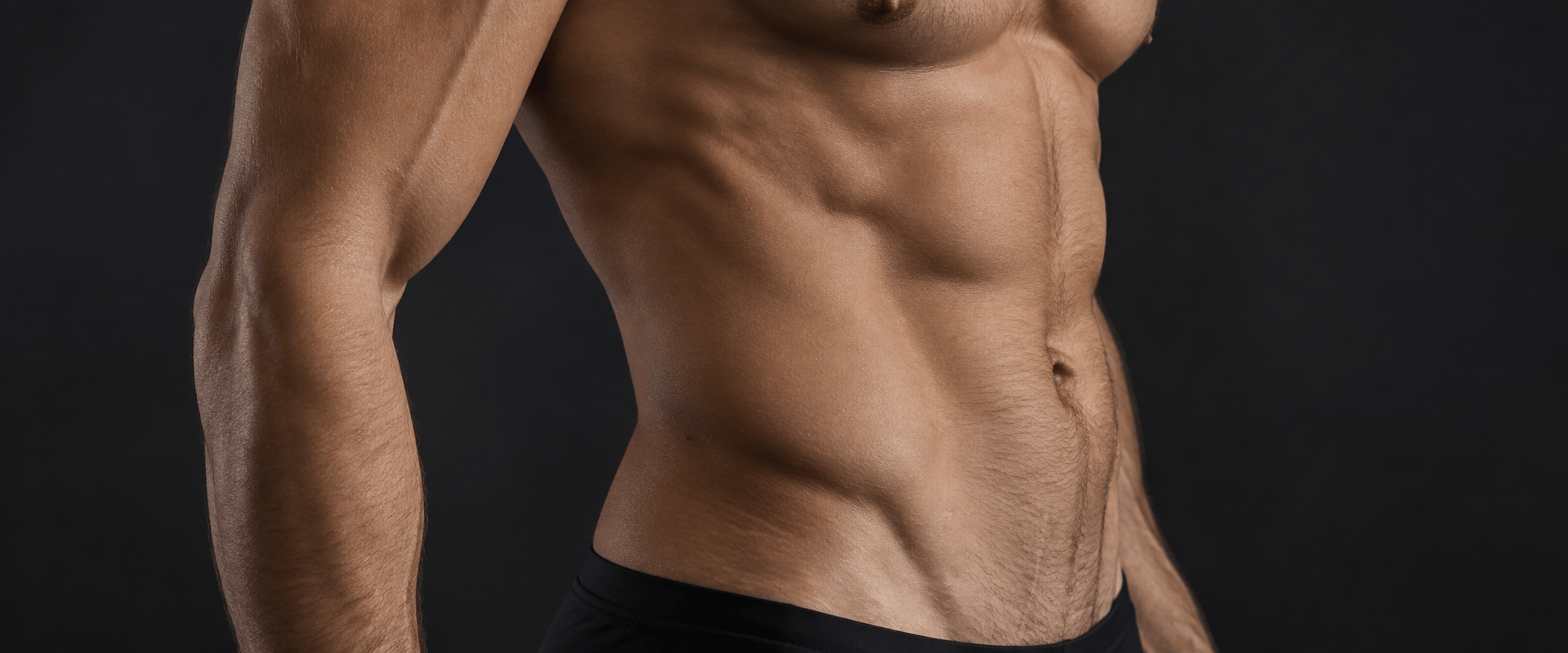
The Waist Doesn’t Stop Where the Abdomen Ends.
Love handles wrap around the sides of the torso — and often become even more noticeable as they approach the lower back.
You can lose weight, strengthen your core and lean out through the chest or abdomen while localized fullness remains over the sides of the waist.
Dr. Jonathan Lebowitz uses VASER 4D Hi-Def liposuction in appropriately selected patients to reduce subcutaneous flank fat while shaping the transition between the abdomen, waist, hips and back.
The Love Handle Is a Three-Dimensional Region.
The flanks sit along the side of the torso between the ribs and hips, connecting the abdomen in front with the lower back behind.
In many patients, the most prominent portion is not directly at the side. The fatty layer can become thicker as it travels toward the back of the waist.
That is why Dr. Lebowitz evaluates the flank as a continuous contour rather than treating only the portion visible from a straight frontal view.
You Can’t Tell Your Body Where to Lose Its Next Inch.
A resistant flank pocket can remain even when overall body composition has changed considerably.
Exercise can strengthen the abdominal wall, obliques and back musculature, and overall fat loss can reduce body fat. But neither allows you to selectively choose the exact fat cells above the hip that shrink first.
For someone at a reasonably stable weight with localized subcutaneous flank fat, surgical contouring can address that specific distribution rather than requiring continued weight loss from areas that are already lean.
Front, Side and Back All Have to Agree.
A flatter abdomen can still look wide when prominent love handles remain on either side.
Likewise, aggressively reducing the flanks without considering the lower back can leave an abrupt transition as the torso turns away from the camera.
Shows whether flank width is interrupting the taper from the upper torso into the waist.
Reveals how much the love handle projects beyond the natural hip and torso line.
Often exposes the transition between the lateral flank and posterior waist most clearly.
Shows whether residual lower-back or posterior flank fullness continues to widen the torso.
The surgical boundary should come from the anatomy — not from where the word “flank” happens to end on a diagram.
The Same Fat Deposit Can Affect Male and Female Proportions Differently.
The original flank page makes a useful point: changing the waist can change how the entire torso is perceived.
In many men, reducing excess flank volume can make the natural transition from a broader chest and back into a narrower waist more visible.
For many women, selected flank reduction can increase the visible contrast between the waist and hips when the underlying skeletal and soft-tissue proportions support that shape.
Reduce the Love Handle Without Flattening the Natural Waist.
VASER is the technology. The contour depends on where and how Dr. Lebowitz uses it.
VASER delivers ultrasound energy within selected subcutaneous fatty tissue to assist with fragmentation and emulsification before the fat is removed through liposuction cannulas.
Across the flanks, Dr. Lebowitz decides where additional reduction will improve the waist and where enough tissue should remain to preserve a smooth transition into the abdomen, hip and back.
Map
Evaluate the waist from the front, sides, three-quarter angles and back.
Prepare
Infiltrate the treatment region and use VASER ultrasound within selected fatty tissue.
Reduce
Aspirate appropriate flank fat according to the desired contour.
Blend
Reassess the treated waist against the abdomen, hip and posterior torso.
Roll to the Side. Let the Love Handle Fall Naturally. Check It Again.
The flank can look very different depending on whether the patient is flat, rotated or lying on one side.
For many appropriately selected flank procedures performed under local anesthesia, the patient remains responsive enough to reposition during portions of the operation.
Dr. Lebowitz can ask the patient to roll toward one side, rotate the torso or change position while he evaluates the developing waistline from another perspective.
This is particularly relevant to the love handles because gravity changes how flank tissue sits depending on body position.
Local anesthesia and active repositioning are not appropriate for every patient or every extent of body contouring. Dr. Lebowitz determines the anesthetic plan individually.
A Flat Stomach and a Wide Waist Are Not the Same Contour.
The abdomen primarily influences the front projection of the torso. The flanks contribute heavily to its width.
A patient can therefore have relatively little central abdominal fat but still feel that the waist looks thick because localized fatty tissue remains along the sides.
Conversely, reducing the love handles alone cannot correct central abdominal fullness caused by a separate fatty layer or deeper abdominal anatomy.
The Largest Part of the Flank May Be Behind the Side Seam.
One of the more useful observations on Dr. Lebowitz’s original page is that flank fullness frequently becomes prominent toward the posterior torso.
That area blends directly into the lower back. If substantial fullness remains there, treating only the true lateral waist can leave the posterior contour unfinished.
Dr. Lebowitz examines where the love handle actually ends before deciding whether the lower back belongs in the treatment plan.
VASER Can Change Fat. It Cannot Move Your Ribs or Pelvis.
Waist width is not determined by love handles alone.
The rib cage, pelvis, oblique musculature, abdominal-wall anatomy and overall skeletal frame all contribute to torso dimensions.
Dr. Lebowitz can reduce appropriate subcutaneous fat that is adding width over that foundation. He cannot liposuction the skeleton into a different proportion.
Sometimes You Notice the Flanks First in a Pair of Pants.
Waistbands can compress the soft tissue above the hip and make an otherwise modest flank pocket look more prominent.
That is why some patients describe the problem less as “love handles” and more as fullness spilling above fitted pants or disrupting how shirts fall around the waist.
Removing selected flank fat can change that contour when subcutaneous volume is truly the cause, but surgery is still planned around the body underneath the clothing — not around a waistband itself.
Fat Reduction and Skin Tightness Are Separate Questions.
VASER removes selected fatty tissue. It does not directly excise loose skin.
After volume is reduced, skin quality influences how the surface re-drapes over the new flank contour. Age, genetics, previous weight change, stretch marks and baseline laxity can all matter.
Dr. Lebowitz evaluates the skin separately from the fat. In selected patients with laxity, he may discuss an adjunct such as Renuvion when appropriate. More substantial redundant skin may require another surgical strategy.
The Best Candidate Has a Love Handle That Is Actually a Fat Problem.
Dr. Lebowitz evaluates fat distribution, weight stability, skin quality, torso anatomy and the relationship between the flanks and surrounding areas.
Localized Love Handles
A meaningful layer of subcutaneous flank fat remains despite otherwise reasonable body proportions.
Reasonably Stable Weight
The goal is reshaping the waist rather than using liposuction as a substitute for significant future weight loss.
Suitable Skin
The skin is expected to adapt reasonably to the proposed reduction or its limitations can be incorporated into the plan.
Realistic Waist Goals
The desired change can come from reducing fat rather than requiring a different rib cage, pelvis or muscular structure.
The Hip Needs a Transition — Not a Cliff.
Love-handle sculpting happens directly above an important change in the body’s underlying frame.
The flank approaches the iliac region of the pelvis, where the torso naturally transitions into the hip. Removing too much tissue in one zone can create an abrupt depression or emphasize adjacent fullness.
Dr. Lebowitz aims to improve the taper while preserving enough soft tissue for the waist to remain smooth and anatomically believable.
Don’t Judge Love Handles From the Front Alone.
The three-quarter and back views may tell you more about flank surgery than the straight frontal photograph.
Look at the change in waist width, the transition above the hip and whether the posterior flank blends naturally into the lower back.
For men pursuing a more athletic contour, assess whether the upper torso now transitions more cleanly into the waist. For other patients, look at whether the natural waist-to-hip relationship has become more apparent without looking artificially carved.
A Sculpted Waist Can Be Long-Lasting — but Your Body Can Still Change.
Liposuction removes fat cells from the treated region, but surgery does not freeze the rest of the body in time.
Remaining fat cells can enlarge with weight gain, and aging, skin changes, muscle changes and future weight fluctuations can alter the waistline.
Maintaining a reasonably stable weight helps preserve the contour created by surgery without making unrealistic promises that the body can never change again.
The Waist Is Sculpted During Surgery. Swelling Decides When You Get to See It Clearly.
Recovery depends on the amount of flank treatment and whether the abdomen, back or other body areas are included in the same procedure.
Move & Follow Instructions
Dr. Lebowitz provides individualized guidance for walking, positioning, incision care and any compression included in the plan.
The Waist May Look Puffy
Postoperative swelling and firmness can temporarily obscure the taper created during surgery.
Core Training Returns Gradually
Heavy lifting, twisting and strenuous exercise resume according to the extent of treatment and individual healing.
The Taper Develops
The flank-to-back and flank-to-abdomen transitions become easier to assess as swelling decreases and tissues settle.
A Smaller Waist Still Comes With Surgical Variables.
Potential complications of liposuction can include swelling, bruising, fluid collections, contour irregularity, asymmetry, changes in sensation, scarring, infection, skin injury, blood clots and the possibility of additional treatment, among other risks.
Ultrasound-assisted liposuction also carries a risk of thermal injury.
Because the flank is a curved transition zone, irregular reduction can become visible as the torso turns. Dr. Lebowitz reviews the risks and limitations relevant to the extent of surgery being considered.
VASER Flank Liposuction FAQs
What exactly are the flanks?
The flanks are the sides of the torso between the ribs and hips. The fatty region commonly called the love handles can extend from the side of the waist toward the lower back, which is why Dr. Lebowitz evaluates the area three-dimensionally.
Can VASER get rid of love handles?
VASER-assisted liposuction can reduce selected subcutaneous flank fat when that tissue is responsible for the unwanted projection. The amount of visible waist narrowing depends on the surrounding anatomy, including the rib cage, pelvis, muscle and adjacent fat distribution.
Why do I still have love handles even though I work out?
Exercise strengthens the underlying musculature and overall fat loss can reduce body fat, but neither lets you choose exactly where fat comes off first. Some people retain a disproportionate flank deposit even when other areas become relatively lean.
Should my abdomen be treated with my flanks?
Not automatically. Dr. Lebowitz evaluates whether the front and sides of the midsection are both contributing to the contour. Some patients have isolated love handles, while others benefit from considering the abdomen and flanks as connected zones.
Should my back be treated too?
The posterior flank often blends into lower-back fullness. Dr. Lebowitz evaluates where the love handle actually ends before deciding whether back treatment would improve the transition. It is not necessary in every patient.
Can VASER give a man more of a V-shaped torso?
Reducing appropriate waist and flank fat may make the contrast between a broader upper torso and narrower waist more apparent. VASER cannot create the underlying shoulder, back or skeletal structure responsible for the V-taper itself.
Can flank liposuction create more of an hourglass shape?
In patients whose natural hip and torso proportions support it, reducing love-handle fullness may increase the visible contrast between the waist and hips. The achievable shape depends on the patient’s existing frame rather than on one standardized contour.
Can flank VASER be performed under local anesthesia?
Dr. Lebowitz performs many appropriately selected flank procedures under local anesthesia. A responsive patient may be able to reposition or roll during portions of surgery so the developing waist can be reassessed from different angles. The anesthetic plan depends on the individual patient and extent of surgery.
Are flank liposuction results permanent?
Liposuction removes fat cells from the treated area and the contour can be long-lasting, particularly when body weight remains reasonably stable. Future weight changes, aging and other body changes can still alter the waist, so the result should not be described as a body shape that can never change.
How long until my waist looks final?
The fat reduction occurs during surgery, but swelling and firmness can obscure the contour afterward. The waist continues evolving as swelling decreases and tissues settle, and the timeline varies according to the amount and extent of treatment.
Talk With Dr. Lebowitz About the Entire Waist — Not Just the Love Handles.
Prospective patients can meet directly with Dr. Jonathan Lebowitz through a live virtual consultation or in person at his Huntington, New York practice.
During the consultation, Dr. Lebowitz can discuss where your flank fullness is most noticeable, how it wraps around the waist and whether the abdomen or lower back may also be affecting the contour you want to change.
He can then explain whether VASER flank liposuction appears appropriate, whether connected areas deserve consideration and whether an in-person examination is needed before establishing the final surgical plan.
If the Love Handles Are Breaking the Taper, Map the Whole Waist Before Treating Either Side.
Dr. Lebowitz can evaluate where the flank fat begins, how far it wraps toward the back, how it connects to the abdomen and what your underlying torso can realistically reveal once that extra width is reduced.