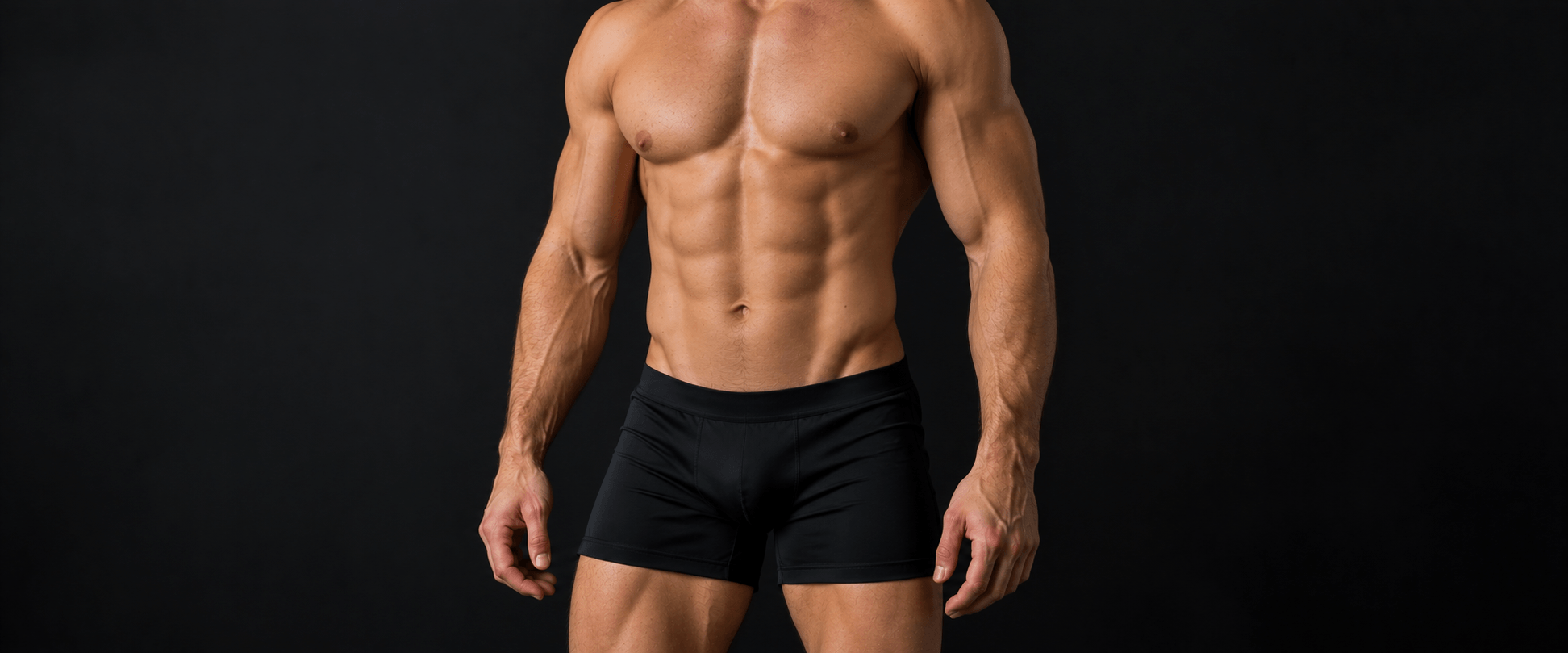
Don’t Just Remove Fat. Sculpt What’s Underneath It.
VASER 4D Hi-Def is Dr. Jonathan Lebowitz’s approach to reducing unwanted fat while shaping the body around its underlying anatomy.
You may already exercise. You may already watch what you eat. But certain areas can remain disproportionately full because you cannot choose exactly where your body stores — or loses — fat.
Dr. Lebowitz uses VASER ultrasound-assisted liposculpting to address selected subcutaneous fat while evaluating muscular borders, transitions between body regions, skin quality and the overall proportions of the physique.
Ultrasound-Assisted Liposuction — Not a Laser
VASER is an ultrasound-assisted liposuction system. During treatment, ultrasound energy is delivered into the fatty layer to help fragment and emulsify selected subcutaneous fat before it is removed through liposuction cannulas.
That distinction matters. VASER is not laser liposuction, and Dr. Lebowitz’s current body-contouring approach should not be confused with older SmartLipo or laser-assisted techniques previously discussed on the website.
The technology is one part of the procedure. The contour ultimately depends on where Dr. Lebowitz removes volume, where he deliberately preserves it and how he blends each treated region into the anatomy around it.
Prepare the Fat. Remove the Fat. Shape the Contour.
The technical process can be described in three basic stages, but the artistry of body contouring comes from how those stages are applied to the individual patient.
Infiltration
A dilute anesthetic solution is introduced into the selected treatment area as part of the surgical and anesthetic plan.
Ultrasound-Assisted Emulsification
A VASER probe delivers ultrasound energy into selected fatty tissue to assist with fragmentation and emulsification before removal.
Aspiration & Sculpting
Dr. Lebowitz removes appropriate fatty tissue through cannulas while repeatedly evaluating the developing shape and transitions.
High Definition Is About Anatomy — Not Drawing Fake Muscles Into Fat.
The objective is to reveal the physique that is actually there, not manufacture anatomy that does not move naturally with the body.
Traditional fat reduction can focus primarily on making an area smaller. Hi-Def liposculpting requires a more three-dimensional approach.
Fat can be reduced strategically around natural muscle boundaries rather than uniformly across an entire region.
The junction between chest, abdomen, flanks, back and other areas matters as much as any one isolated treatment zone.
A contour should continue to make sense when the patient changes position or contracts the underlying muscles.
A highly defined abdomen can look unnatural if the chest, flanks or surrounding torso do not support the same overall physique.
The appropriate degree of definition depends on your existing muscle development, fat distribution, skin quality and overall body composition. Not every patient should be sculpted to the same degree.
VASER Is Designed to Change Shape, Not the Number on the Scale.
The best question is not “How many pounds can you remove?” It is “Which areas are disrupting the proportions of my body?”
VASER liposuction removes selected subcutaneous fat. It does not treat visceral fat deep inside the abdomen, does not replace healthy weight management and is not intended by itself to produce significant weight loss.
For many body-contouring patients, the objective is therefore not a dramatic change in body weight. It is a more meaningful change in shape, definition and proportion.
The Starting Anatomy Determines How Far the Sculpting Can Go.
Dr. Lebowitz evaluates more than whether you have fat that can be removed. The quality of the result also depends on what lies beneath that fat and how the skin is likely to behave afterward.
Localized Fat
You have specific areas of subcutaneous fat that remain disproportionate to the rest of your body.
Stable Body Composition
Your weight is reasonably stable rather than actively moving through a major loss or gain.
Underlying Anatomy
You have muscular contours or body proportions that can be revealed and refined as the fatty layer is reduced.
Realistic Expectations
You understand that liposculpting can reshape the fatty layer but cannot create muscles, eliminate every irregularity or make loose skin disappear.
From the Neck to the Calves — and Everything in Between.
Dr. Lebowitz uses VASER in multiple body regions. Some patients treat one highly focused area. Others need several connected areas addressed together so the finished contour flows naturally from one region into the next.
Neck & Jawline
Reduce selected submental and neck fat to improve the transition between the face, jawline and neck.
Upper Arms
Address fatty fullness while evaluating muscular shape and the quality of the surrounding skin.
Abdomen
Reduce superficial abdominal fat and sculpt around natural abdominal anatomy where appropriate.
Flanks
Reduce love-handle fullness and improve the transition between the abdomen, waist and lower back.
Back
Address selected back fat while shaping its relationship with the waist, flanks and lateral torso.
Thighs
Refine selected thigh fullness while preserving proportion with the hips, knees and lower legs.
Knees
Target localized fatty pockets around the knee when they disrupt the transition between thigh and lower leg.
Calves
Refine selected fatty fullness where appropriate while evaluating the natural shape of the lower leg.
Male Chest
VASER may be combined with gland removal when fat contributes to gynecomastia or broader male chest fullness.
The Abdomen Is Not One Flat Sheet of Fat.
The abdomen is one of the areas where the difference between simple fat removal and anatomical sculpting becomes especially important.
Dr. Lebowitz considers the central abdomen, lower abdomen, waist, natural muscular separations and the way the abdomen connects to the chest and flanks.
In an appropriately developed patient, reducing selected superficial fat can reveal more of the existing abdominal architecture. The goal is not to carve a rigid six-pack that looks the same while standing, sitting, relaxing and flexing.
Not Every Protruding Abdomen Is Caused by Fat That Liposuction Can Remove.
A visibly rounded abdomen can contain both subcutaneous fat, which lies above the abdominal muscle wall, and visceral fat, which lies deeper inside the abdominal cavity around the internal organs.
VASER liposuction addresses appropriate subcutaneous fatty tissue. It does not remove visceral fat.
Fat beneath the skin and above the muscular wall may be accessible to liposuction.
Internal abdominal fat lies deeper than the muscle wall and is not treated with liposuction.
Dr. Lebowitz evaluates what component is creating the abdominal contour before recommending surgery.
Local Anesthesia Can Become Part of the Sculpting Process.
For many appropriately selected procedures, Dr. Lebowitz performs VASER body contouring with the patient awake under local anesthesia in his private surgical setting in Huntington, New York.
For Dr. Lebowitz, that can provide more than anesthesia alone. A responsive patient can change position and activate specific muscle groups while the contour is being developed.
Depending on the area being treated, he may ask you to raise your arms, roll, turn, twist, flex, crunch or contract specific muscles. That lets him reassess how the remaining fatty layer and skin move over the anatomy beneath them.
A transition that looks smooth in one position may look different when the body moves. Dynamic reassessment gives Dr. Lebowitz another way to evaluate the developing contour throughout the procedure.
Local anesthesia is not appropriate for every patient or every extent of body contouring. Dr. Lebowitz determines the anesthetic and surgical plan according to your health, anatomy, treatment areas and overall procedure.
Your Abdomen Does Not End Where Your Flanks Begin.
One of the limitations of treating isolated areas is that the human body has no visible lines separating “abdomen,” “flanks” and “back.” Those areas flow directly into one another.
If the abdomen becomes dramatically leaner but the flanks remain full, the result may still look unbalanced. Likewise, sculpting the waist without considering the back can leave abrupt transitions.
Dr. Lebowitz evaluates the body circumferentially and determines whether one area can be treated successfully on its own or whether connected regions should be included in the same overall plan.
What Happens to the Skin After the Volume Underneath It Is Reduced?
Removing fat changes what is supporting the skin from below. How that skin re-drapes depends on elasticity, age, weight history, previous stretching and the amount of volume being removed.
VASER should not be presented as a substitute for removing genuinely redundant skin. When skin quality is a significant part of the problem, Dr. Lebowitz evaluates that separately.
In selected patients, he may incorporate Renuvion as an adjunct when additional treatment of skin laxity is appropriate. Patients with more substantial excess skin may need a different operation entirely.
Strategic Fat Grafting Can Complement Fat Removal.
Body contouring is not always about taking volume away everywhere.
In selected patients, Dr. Lebowitz may use harvested fat to add volume to an area where additional projection, balance or muscular emphasis would improve the overall contour.
The decision to graft fat depends on the treatment plan and available donor fat. Fat retention can vary, so transferred volume should not be presented as perfectly predictable.
Neck to Nuts
For some men, treating one pocket of fat is not enough to change the overall physique.
Dr. Lebowitz’s Neck to Nuts approach evaluates the male body as one connected contour — potentially incorporating the neck, chest, abdomen, waist, flanks, back and other areas according to the patient’s anatomy.
It is not a predetermined package and does not mean every patient has every region treated. It is a comprehensive planning philosophy: identify what disrupts the body’s proportions and build one individualized plan around it.
VASER Does Not Decide Where the Contour Should Go. The Surgeon Does.
Two surgeons can use the same device and create very different body contours. Planning, anatomy, judgment and repeated reassessment matter at least as much as the technology itself.
Mark the Anatomy
Dr. Lebowitz plans around muscular borders, fat distribution and transitions between treatment areas rather than simply outlining a bulge.
Remove Selectively
The goal is not necessarily to make every layer equally thin. Strategic differences in thickness contribute to natural shape.
Evaluate Dynamically
Where appropriate, movement and muscle contraction can help reveal how the developing contour behaves beyond a static surgical position.
Refine the Whole Body
Dr. Lebowitz considers how each treated region relates to the patient’s complete physique rather than judging it in isolation.
Look Beyond “How Much Fat Came Out.”
The amount removed does not tell you whether the body was sculpted well.
When reviewing VASER results, look at the waistline, muscular borders, symmetry, skin quality and how one treated region transitions into the next. The most useful comparisons are patients whose starting build and treatment areas resemble your own.
Recovery Depends on How Much of the Body Was Treated.
A small neck procedure and comprehensive torso sculpting are very different operations, so Dr. Lebowitz individualizes postoperative instructions according to the extent and location of treatment.
Compression
Compression garments may be prescribed to support selected treatment areas and help manage postoperative swelling.
Swelling & Firmness
The early contour is not the final result. Swelling, firmness and internal healing can temporarily obscure definition.
Movement & Activity
Routine movement generally returns before strenuous exercise. Timing varies according to the extent of surgery and the areas treated.
Continued Refinement
The contour continues changing as swelling resolves, tissues soften and the skin settles around the new shape.
VASER Is Surgery — Not a Non-Surgical Body Treatment.
VASER-assisted liposuction involves surgical access, ultrasound energy and aspiration of fatty tissue. Like other surgical procedures, it has risks and limitations.
Possible complications can include contour irregularity, asymmetry, swelling, bruising, fluid collections, infection, changes in sensation, skin injury, scarring and the need for additional treatment, among other risks that Dr. Lebowitz will review with you.
The appropriate procedure depends on your health, anatomy, treatment area and extent of surgery. A consultation is necessary to determine candidacy and discuss the risks that apply to your individual plan.
VASER 4D Hi-Def FAQs
What is VASER liposuction?
VASER is an ultrasound-assisted liposuction technology used to help fragment and emulsify selected subcutaneous fatty tissue before it is aspirated. Dr. Lebowitz uses the technology as part of his individualized body-sculpting approach.
Is VASER a laser?
No. VASER uses ultrasound energy. It should not be confused with laser-assisted liposuction or older SmartLipo terminology.
What is the difference between VASER liposuction and VASER Hi-Def?
VASER describes the ultrasound-assisted technology used during fat removal. Hi-Def describes a more anatomical sculpting approach in which Dr. Lebowitz considers muscular borders, strategic areas of reduction and the transitions between adjacent body regions rather than treating the fatty layer uniformly.
Can VASER give me six-pack abs?
VASER cannot create abdominal muscles that are not present. In appropriately selected patients with suitable anatomy, reducing selected superficial fat may reveal more of the underlying muscular structure. Dr. Lebowitz determines how much definition is appropriate for the individual physique.
Is VASER a weight-loss procedure?
No. VASER is intended for aesthetic body contouring through removal of selected subcutaneous fat. It does not treat visceral fat and should not be viewed as a substitute for significant weight loss.
Can several areas be treated at once?
Multiple connected areas may be incorporated into one body-contouring plan when Dr. Lebowitz considers that appropriate. How much can reasonably be treated in one procedure depends on your health, anatomy, treatment goals and the extent of surgery.
Does VASER tighten loose skin?
Skin can re-drape to varying degrees after underlying volume is reduced, but VASER should not be treated as a replacement for removing substantial excess skin. Dr. Lebowitz evaluates elasticity separately and may discuss adjunctive skin treatment such as Renuvion or direct skin excision where appropriate.
Can VASER be performed under local anesthesia?
Dr. Lebowitz performs many appropriately selected VASER body-contouring procedures under local anesthesia. This can also allow a responsive patient to reposition or activate specific muscles while Dr. Lebowitz reassesses the contour. The anesthetic plan depends on the patient and extent of surgery.
Will the fat come back after VASER?
Fat cells removed from the treated area are physically removed, but the remaining fat cells can enlarge with future weight gain and the body’s proportions can continue changing with aging and weight fluctuation. Maintaining a relatively stable weight helps preserve the contour over time.
Start With Dr. Lebowitz From Wherever You Live.
Patients considering VASER 4D Hi-Def travel to Dr. Lebowitz’s Huntington, New York practice from throughout the United States and abroad. You can begin with a virtual consultation before deciding whether to travel for surgery.
For out-of-town patients, the treatment plan should also account for the extent of surgery, postoperative follow-up and how long Dr. Lebowitz recommends remaining locally before traveling home.
Find Out What Can Be Reduced — and What Can Be Revealed.
Dr. Lebowitz can evaluate your fat distribution, muscular anatomy, skin quality and overall proportions and discuss the VASER 4D Hi-Def body-contouring approach he would consider for you.