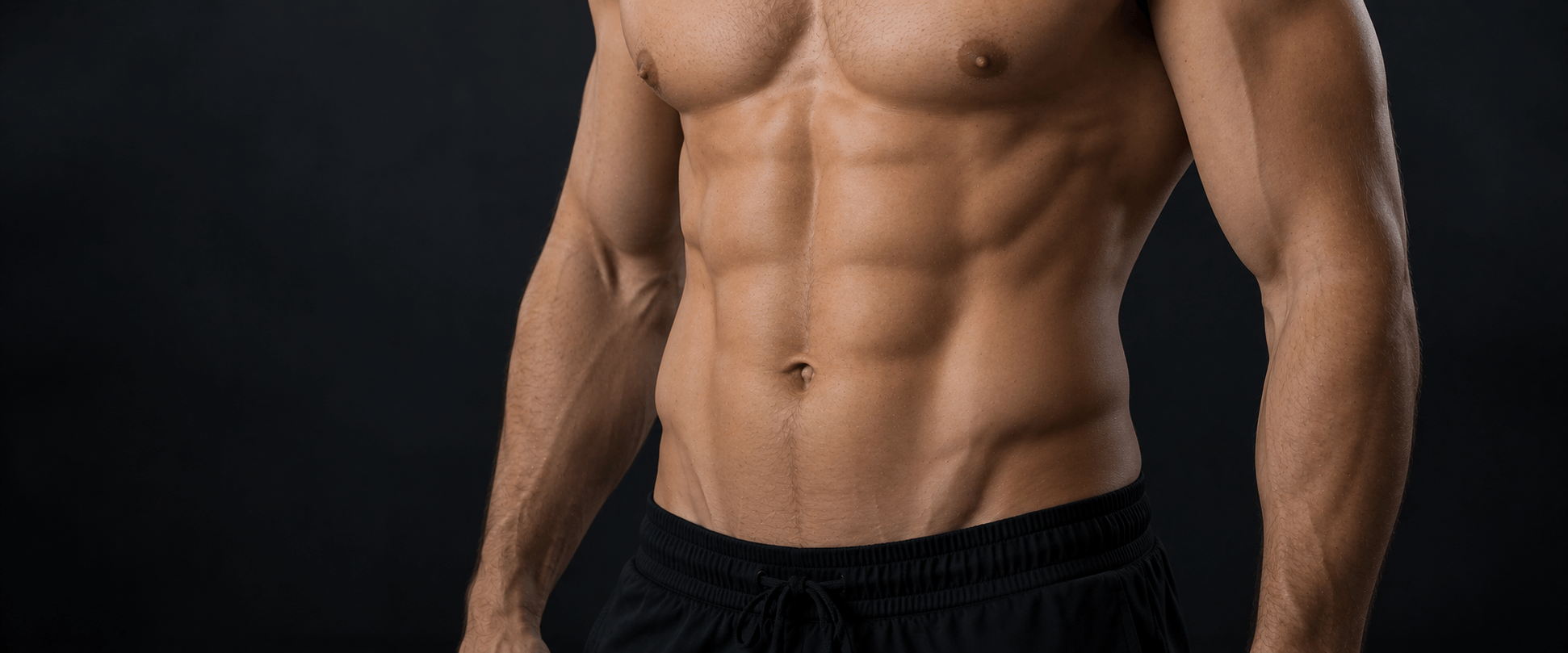
Your Waist Can Get Leaner While the Lower Belly Refuses to Cooperate.
The abdomen is often where “just lose a little more weight” stops being a useful answer.
You can train consistently, improve your diet and change the rest of your physique while a stubborn layer of fat remains across the stomach — particularly through the lower abdomen and waist.
Dr. Jonathan Lebowitz uses VASER 4D Hi-Def liposuction to reduce selected subcutaneous abdominal fat while evaluating the muscular structure, waistline, skin and surrounding torso that determine what the midsection actually looks like.
What Is Actually Making the Abdomen Project?
A protruding stomach does not automatically mean there is a large amount of fat that liposuction can remove.
The visible abdominal profile can come from several different anatomical layers. Dr. Lebowitz evaluates which ones are contributing before deciding whether VASER is the right treatment.
Sometimes the Last Place to Lean Out Is the First Place You Notice.
A relatively small lower-abdominal pocket can interrupt the entire line of an otherwise fit torso.
Fat distribution is not perfectly uniform. Some people remain disproportionately full below the navel even after the upper abdomen, chest, arms or other areas have become considerably leaner.
VASER allows Dr. Lebowitz to focus on the fatty layer actually affecting that contour rather than requiring the rest of the body to become unnecessarily thinner in an attempt to change one resistant region.
Thin the Fatty Layer Without Treating the Abdomen Like a Flat Sheet.
The stomach has contours, boundaries and muscular changes in depth. Hi-Def sculpting works with those differences instead of erasing them.
VASER uses ultrasound-assisted technology to help fragment and emulsify selected subcutaneous fatty tissue before Dr. Lebowitz removes it through liposuction cannulas.
The technology helps him work within the fatty layer. The surgical judgment lies in determining where to reduce more, where to preserve appropriate thickness and how to transition between adjacent anatomical zones.
Map
Evaluate the abdomen, muscle boundaries, waist, flanks and surrounding torso.
Prepare
Infiltrate the treatment area and use VASER ultrasound within selected fatty tissue.
Sculpt
Aspirate appropriate fat while developing the abdominal shape rather than simply maximizing removal.
Reassess
Review the contour repeatedly from different positions and, where possible, with the musculature active.
Crunch. Hold. Relax. Let the Muscle Show Him Where the Contour Really Is.
The abdominal wall changes when you tighten it — and Dr. Lebowitz can use that movement as another source of information while sculpting.
For appropriately selected procedures performed under local anesthesia, the patient remains responsive. Dr. Lebowitz can ask you to tighten the abdomen in a crunch, contract different areas of the core, relax and change position while he evaluates the developing result.
A contracted abdominal wall provides a different view and feel from a completely relaxed abdomen. It can help clarify the relationship between the remaining fatty layer and the muscular structure immediately beneath it.
This dynamic approach is particularly relevant to abdominal Hi-Def work because definition should make sense both when the abdomen is active and when the body returns to a natural resting position.
Local anesthesia and active patient participation are not appropriate for every patient or every extent of abdominal surgery. Dr. Lebowitz determines the anesthetic plan individually.
A Six-Pack Should Move Like a Six-Pack.
One of the strongest ideas on Dr. Lebowitz’s original abdomen page is the distinction between revealing abdominal anatomy and creating an artificially etched pattern that looks disconnected from the body.
Real abdominal muscles change as you breathe, bend, relax and contract. Definition that is appropriate when the core is flexed should not necessarily remain equally rigid while the abdomen is relaxed.
Dr. Lebowitz uses the muscular anatomy already present as the blueprint. VASER can reduce selected overlying fat; it cannot manufacture abdominal muscles that do not exist underneath.
Dr. Lebowitz Doesn’t Draw the Same Abs on Everybody.
No two abdominal walls have exactly the same proportions. Muscle development, tendon intersections, torso length, rib cage, pelvis and natural asymmetries all affect the visible architecture of the midsection.
The appropriate sculpting pattern should therefore come from your anatomy, rather than forcing a standard six-pack template onto every patient.
Subcutaneous Fat and Visceral Fat Are Not the Same Problem.
Subcutaneous fat lies beneath the skin and above the abdominal-wall musculature. This is the fatty layer treated by liposuction.
Visceral fat lies deeper, inside the abdominal cavity. It can push the entire abdominal wall outward but cannot be removed with VASER or any other form of liposuction.
This is why two men with similarly sized stomachs can be very different VASER candidates. Dr. Lebowitz evaluates the anatomy rather than estimating candidacy by belly size alone.
The Best Candidates Have a Contour Problem Liposuction Can Actually Change.
Dr. Lebowitz looks at where the abdominal volume is located, the quality of the skin and what shape is realistically available underneath the fatty layer.
Pinchable Abdominal Fat
There is a meaningful subcutaneous fatty layer contributing to the unwanted abdominal contour.
Reasonably Stable Weight
The goal is contour refinement rather than using liposuction as a substitute for substantial future weight loss.
Useful Skin Quality
The skin has enough elasticity to participate appropriately in the planned reduction, or its limitations can be addressed separately.
A Realistic Anatomical Goal
You want a flatter or more defined midsection based on the body you actually have rather than a guaranteed replica of someone else’s abdomen.
Sometimes the Abdomen Isn’t the Only Area That Needs Attention.
A leaner stomach can still look broad when significant fullness remains at the flanks. Likewise, aggressively reducing the central abdomen without blending it into the sides can produce an abrupt transition.
Dr. Lebowitz evaluates the abdomen in the context of the waist, love handles and lower back before determining where treatment should stop.
The answer is not automatically to treat every area. It is to understand how the areas work together before sculpting any one of them.
A Flatter Fatty Layer Still Needs a Skin Envelope That Can Follow It.
Once abdominal volume is reduced, the overlying skin must re-drape around the new shape.
Age, genetics, previous weight changes, stretch marks, the degree of existing laxity and the amount of tissue reduction all influence how the skin behaves.
Dr. Lebowitz assesses the skin separately from the fat. In selected patients with laxity, he may discuss adjunctive treatment such as Renuvion. More substantial redundant skin may require a different operation.
They Treat Different Layers of the Problem.
If the primary issue is subcutaneous fat, VASER may be the conversation. If the dominant problem is substantial loose skin or abdominal-wall laxity, removing fat alone may not solve it.
Primarily a Fat-Contouring Operation
Targets selected subcutaneous fat and reshapes the fatty layer through relatively small surgical access sites.
Primarily a Skin & Abdominal-Wall Operation
Can remove substantial redundant abdominal skin and, when required, address weakened or separated abdominal-wall structures.
Some patients fall between these categories. Dr. Lebowitz evaluates the trade-off between the amount of improvement expected from liposculpting and the scars or additional surgery required to address more substantial skin excess.
The fact that someone wants to avoid a tummy-tuck scar does not automatically mean VASER alone will produce the abdominal contour he or she wants. The anatomy has to support the plan.
The Goal Isn’t the Emptiest Abdomen. It’s the Best-Shaped Abdomen.
More aggressive fat removal does not automatically create more definition.
If an area is made disproportionately thin, the surface may look unnatural or transition poorly into adjacent regions. High-definition sculpting depends on a controlled relationship between thicker and thinner areas across the abdomen.
Look at the Waist. Look at the Lower Belly. Then Look at the Abs When They Move.
Do not evaluate an abdominal result from one frontal photograph alone.
Compare the upper and lower abdomen, side profile, waist and flanks. Look for symmetry and believable transitions. Video can be particularly useful in Hi-Def cases because it shows whether the contour still makes sense as the patient relaxes, turns and flexes.
The Definition Is There Before All the Swelling Is Gone.
The abdomen commonly develops postoperative swelling, firmness and temporary irregularity. The contour becomes easier to judge as those changes resolve and the tissues continue settling.
Move & Recover
Dr. Lebowitz provides instructions for walking, daily activity, wound care and any compression required after surgery.
Swelling Evolves
The abdomen may feel firm or look temporarily less defined while internal healing continues.
Training Returns
Abdominal workouts, heavy lifting and strenuous exercise resume according to the extent of treatment and Dr. Lebowitz’s instructions.
The Contour Matures
The midsection can continue changing for months as swelling decreases and tissues soften and settle.
VASER of the Abdomen Is Still a Surgical Procedure.
Potential issues after VASER-assisted abdominal liposuction can include swelling, bruising, contour irregularities, asymmetry, fluid collections, changes in sensation, scarring, infection, skin injury and the possibility of additional treatment, among other surgical risks.
Hi-Def sculpting also places a premium on smooth transitions and symmetry, so even relatively small irregularities can be visible in a leaner abdomen.
Dr. Lebowitz reviews the risks, limitations and expected recovery based on the actual extent of your planned operation.
VASER Abdomen FAQs
Can VASER get rid of my lower belly fat?
VASER can be used to remove selected subcutaneous fat in the lower abdomen when that fatty layer is contributing to the bulge. It cannot remove visceral fat located deeper inside the abdominal cavity, and loose skin or abdominal-wall laxity may require separate consideration.
Can VASER give me a six-pack?
VASER cannot create abdominal muscles. In an appropriately selected patient, reducing selected fat over existing muscular anatomy may make that structure more visible. Dr. Lebowitz bases the sculpting pattern on the patient’s actual anatomy rather than applying the same etched pattern to everyone.
Why does Dr. Lebowitz ask patients to crunch or flex during surgery?
When a procedure is appropriately performed under local anesthesia, a responsive patient can contract the abdominal musculature while Dr. Lebowitz evaluates the relationship between the fatty layer and underlying muscle. The contour can then be reassessed in both active and relaxed positions.
How do I know whether my belly is subcutaneous or visceral fat?
You should not rely solely on a home pinch test. Dr. Lebowitz evaluates the abdominal wall and distribution of tissue during consultation. A protruding abdomen may reflect subcutaneous fat, visceral fullness, skin laxity, abdominal-wall anatomy or a combination.
Should my flanks be treated with my abdomen?
Not automatically. Dr. Lebowitz evaluates how flank fullness affects the waist and how the abdomen transitions into the surrounding torso. Some patients need only abdominal treatment while others benefit from incorporating adjacent areas into the contouring plan.
What is the difference between VASER abdomen liposuction and a tummy tuck?
VASER liposuction primarily treats selected subcutaneous fat. A tummy tuck can remove substantial redundant skin and can address weakened or separated abdominal-wall structures when appropriate. Dr. Lebowitz determines which anatomical problem is responsible for the contour before recommending an approach.
Can VASER tighten abdominal skin?
Skin may re-drape to varying degrees after underlying volume is reduced, but significant loose skin should not be expected to disappear simply because fat is removed. Dr. Lebowitz evaluates skin quality separately and may discuss adjunctive treatment such as Renuvion or direct skin excision where appropriate.
Can abdominal VASER be done under local anesthesia?
Dr. Lebowitz performs many appropriately selected VASER abdominal procedures under local anesthesia. The appropriate anesthetic approach depends on the patient’s health, the amount of treatment planned and whether other body regions are being treated at the same time.
When can I return to abdominal workouts?
The timing varies with the extent of surgery and individual healing. Dr. Lebowitz gives specific postoperative instructions regarding core training, heavy lifting and other strenuous exercise rather than using one recovery date for every patient.
Your Midsection Can Be Evaluated Before You Book the Flight.
Out-of-town patients can begin with a virtual consultation and submit photographs showing the abdomen from multiple angles.
If surgery appears worth considering, Dr. Lebowitz can discuss what he would need to assess in person, whether adjacent areas such as the flanks may matter and how the proposed extent of treatment affects your stay in Huntington.
See What Your Abdomen Can Reveal When the Extra Layer Comes Down.
Show Dr. Lebowitz the upper abdomen, lower belly and waist that have resisted the changes you’ve made elsewhere. He can evaluate what is removable fat, what lies deeper, how the skin may behave and whether Hi-Def sculpting fits the anatomy underneath.