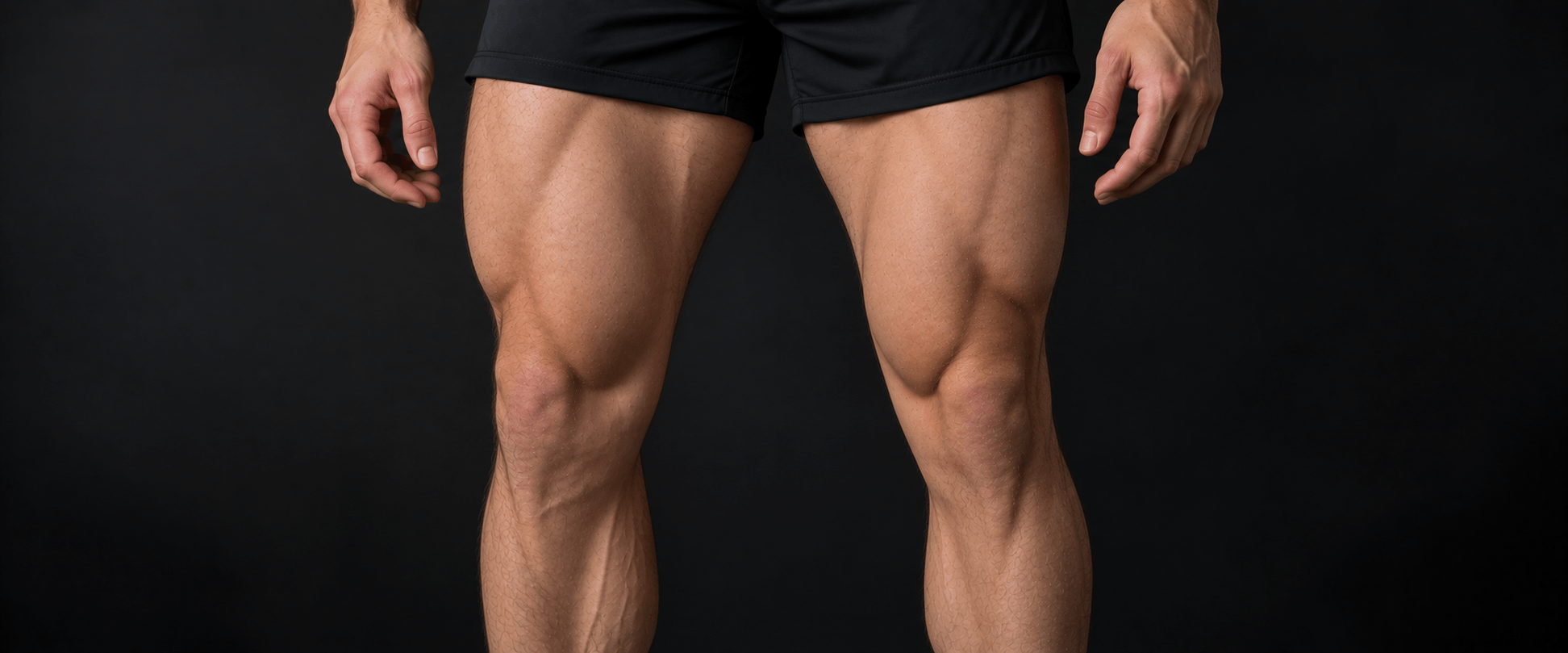
A Small Pocket of Fat Can Change the Line of the Entire Leg.
The knee is not a large treatment area — but visually, it sits exactly where the thigh becomes the lower leg.
Localized fullness along the inner knee or immediately above the knee can interrupt an otherwise lean leg, make the knee appear heavier and soften the transition into the calf.
Dr. Jonathan Lebowitz uses VASER 4D Hi-Def liposuction in appropriately selected patients to reduce specific subcutaneous fat deposits around the knee while preserving the natural contours of the joint and blending the area into the thigh and lower leg.
The Knee Is a Transition Zone — Not an Isolated Circle.
What bothers someone about the knee may actually be the way the entire leg changes direction at that point.
The inner thigh narrows toward the knee. The lower leg then widens through the calf before tapering again toward the ankle.
Even a relatively modest pocket of fat at the medial knee can interrupt that sequence and create a straighter, heavier-looking leg line.
Dr. Lebowitz therefore evaluates the knee in relation to the areas immediately above and below it rather than sculpting to an artificial boundary.
A Fatty Knee and a Swollen Knee Are Two Different Problems.
A long-standing, soft area of localized fullness may represent subcutaneous fat that can potentially be contoured.
But a knee can also enlarge because of joint fluid, inflammation, injury, arthritis, bursitis or other medical conditions. VASER does not treat those problems.
Stable cosmetic fullness may be evaluated as a possible fat-contouring concern.
A recent change in knee size should not automatically be assumed to be fat.
Symptoms involving the joint deserve medical evaluation rather than cosmetic treatment alone.
Inflammatory or infectious causes need to be excluded before aesthetic surgery is considered.
A new, painful, warm, red or rapidly swollen knee should be medically evaluated before any cosmetic treatment is considered.
Sometimes the Problem Is Only a Few Centimeters Wide.
Localized fat along the medial, or inner, knee can be disproportionately noticeable because it projects into the space between the legs.
It may remain even when the thigh and calf are relatively lean, producing a small bulge that interrupts the inward taper of the leg.
For the right patient, the objective is not aggressive circumferential knee reduction. It is selective correction of the area that is disturbing the contour.
The Distal Thigh Can Be Part of What Makes the Knee Look Heavy.
Not all knee-area fullness sits directly beside the joint. Some patients carry excess subcutaneous fat just above the knee, where the lower thigh transitions toward the kneecap.
If that region is disproportionately full, the knee can appear wider or less defined even when the joint itself is not the source of the problem.
This Is a Small Area Where Precision Matters More Than Volume.
Knee liposuction is not about how much fat can be collected. It is about changing a specific contour without over-treating the tissue surrounding a highly visible joint.
VASER uses ultrasound energy within selected subcutaneous fatty tissue to assist with fragmentation and emulsification before aspiration.
Dr. Lebowitz then removes the amount of fat appropriate for the anatomy while repeatedly evaluating how the treated region connects to the thigh and lower leg.
Identify
Determine exactly where removable fatty fullness begins and ends.
Prepare
Infiltrate the treatment area and use VASER ultrasound within selected fatty tissue.
Reduce
Aspirate appropriate fat without chasing unnecessary maximum removal.
Blend
Reassess the transition into the thigh, calf and opposite knee.
The Knee Should Still Look Like a Knee.
Natural knees contain prominences, depressions, tendons and changes in contour created by the joint underneath.
The purpose of VASER is not to erase that anatomy or carve sharply around the kneecap.
Dr. Lebowitz focuses on reducing unwanted superficial fatty fullness while retaining enough soft tissue to keep the knee surface smooth and anatomically believable.
Straighten It. Bend It. Stand on It. Look at the Contour Again.
A knee that looks smooth with the leg fully extended may change as the joint flexes and the surrounding tissues shift.
For appropriately selected procedures performed under local anesthesia, Dr. Lebowitz may be able to reassess the leg with changes in position while the patient remains responsive.
Depending on the surgical plan, he can evaluate how the treated area behaves as the knee position changes and how the inner-knee contour relates to the thigh and calf.
The purpose is not movement for its own sake. It is another way to judge a contour surrounding a joint that is designed to move.
Local anesthesia and active repositioning are not appropriate for every patient or every procedure. Dr. Lebowitz determines the anesthetic and surgical approach individually.
Follow the Inner-Leg Line Up Before Deciding Where Treatment Should Stop.
The inner knee and inner thigh are visually connected. In some patients, the small knee pocket is isolated. In others, fatty fullness continues upward into the lower or medial thigh.
Treating only the knee when the contour problem extends substantially above it can leave an abrupt difference in thickness.
Dr. Lebowitz evaluates that entire line before deciding whether the knee can be treated alone or whether the thigh deserves consideration as part of the same plan.
A Refined Knee Should Flow Into the Calf — Not End Above It.
The lower leg begins visually at the knee. The calf widens beneath it and eventually tapers toward the ankle.
If the calf itself carries substantial fatty fullness, changing only the knee may not create the overall leg proportion the patient has in mind.
Dr. Lebowitz therefore evaluates the calf even when the consultation begins with the knee.
Equal Fat Removal Does Not Automatically Create Equal Knees.
Natural asymmetry can come from differences in fat distribution, leg alignment, muscle development, bone structure or previous injury.
Dr. Lebowitz compares both sides before deciding how much tissue should be treated. One knee may require a different approach from the other.
Removing Fat Doesn’t Remove Loose Skin Around the Knee.
The skin surrounding the knee repeatedly folds and stretches as the leg bends.
After fat reduction, skin elasticity influences how the surface settles around the smaller underlying contour. Age, weight history and baseline skin quality can all affect that response.
Dr. Lebowitz evaluates the skin separately and avoids assuming that removing more fat will automatically make loose tissue around the knee tighter.
The Best Candidate Has a Small, Stable Contour Problem That Is Actually Fat.
Dr. Lebowitz evaluates whether the fullness is subcutaneous fat, whether the surrounding leg is proportional and whether the skin and joint are appropriate for cosmetic treatment.
Localized Inner-Knee Fat
A persistent fatty pocket is disrupting the medial leg line despite otherwise stable body composition.
Fullness Above the Knee
Selected subcutaneous tissue in the lower thigh contributes to a heavy-looking transition into the knee.
Stable, Painless Appearance
The concern is cosmetic and long-standing rather than new joint swelling, inflammation or injury.
Realistic Expectations
The goal is refinement of existing leg anatomy rather than dramatically changing the shape of the knee joint itself.
The Area Is Small. Access Still Has to Be Planned for the Contour.
VASER-assisted knee liposuction is performed through small surgical access sites that allow Dr. Lebowitz to reach the selected fatty tissue with the ultrasound probe and aspiration cannulas.
The exact number and position depend on where the fatty deposits are located and the directions required to blend the contour safely and effectively.
Where appropriate, access points are positioned in less conspicuous locations or natural creases. Every incision creates a scar, and scar appearance varies as healing progresses.
Knee Sculpting Is About Placement — Not the Amount in the Canister.
Because the treatment area is small, relatively modest fat reduction can create a visible change when it is performed in the right location.
That is also why chasing maximum removal makes little sense around the knee. The surrounding leg needs natural soft-tissue coverage and gradual transitions.
Look at the Line of the Leg — Not Just a Close-Up of the Knee.
The most useful comparison shows enough of the thigh and calf to reveal whether the transition through the knee has actually improved.
Pay attention to the inner-leg silhouette, the region immediately above the knee and symmetry between sides. A small change around the joint should make sense within the larger leg rather than looking like an isolated hollow.
A Small Treatment Area Can Still Swell Around a Joint You Use All Day.
Postoperative swelling, bruising and temporary firmness can make the knee look fuller before the refined contour becomes easier to appreciate.
Walk as Directed
Dr. Lebowitz provides individualized instructions for movement, access-site care and any compression included in the postoperative plan.
Don’t Judge Too Early
The area around the knee can temporarily look puffy while postoperative swelling is present.
Exercise Returns Gradually
Running, squatting and strenuous lower-body training resume according to the extent of treatment and individual healing.
The Leg Line Emerges
The relationship between the thigh, knee and calf becomes easier to evaluate as swelling resolves over time.
VASER Around the Knee Still Requires Careful Surgical Planning.
Potential complications of liposuction include swelling, bruising, fluid accumulation, contour irregularity, asymmetry, changes in sensation, scarring, infection, skin injury and the possibility of additional treatment.
Ultrasound-assisted liposuction also carries the possibility of thermal injury.
Because the knee is a relatively compact area with underlying joint anatomy and visible surface landmarks, unnecessary over-treatment should be avoided.
VASER Knee Liposuction FAQs
Can liposuction really be performed around the knees?
Yes. Selected subcutaneous fat around the knee can be treated with liposuction in appropriately selected patients. Dr. Lebowitz evaluates exactly where the fatty tissue sits and whether reducing it can improve the surrounding leg contour.
Where does knee fat usually collect?
Localized fullness is commonly seen along the inner knee and may also occur immediately above the knee as the lower thigh approaches the joint. The pattern varies between patients.
Will VASER fix a swollen knee?
No. VASER contours subcutaneous fat. True joint swelling, fluid accumulation, inflammation, injury, bursitis, arthritis and other medical causes of knee enlargement require appropriate medical evaluation and are not treated with cosmetic liposuction.
Should my thighs be treated at the same time?
Not automatically. Some patients have an isolated inner-knee pocket, while others have fullness that continues into the medial or lower thigh. Dr. Lebowitz evaluates the entire transition before determining where treatment should stop.
What about my calves?
The calf helps determine how the knee appears in proportion. Dr. Lebowitz evaluates the lower leg as part of the overall silhouette even when only the knee is ultimately treated.
Can VASER make my legs look slimmer?
Removing a localized fatty bulge can improve the continuity of the leg line and may create a leaner visual impression. The degree of change depends on the thigh, knee, calf, muscle and skeletal anatomy that remain.
Can knee VASER be performed under local anesthesia?
Dr. Lebowitz performs many appropriately selected VASER procedures under local anesthesia. The anesthetic approach depends on the patient’s health, treatment area and whether the knees are being combined with more extensive thigh, calf or body contouring.
Where are the incisions?
Small access sites are positioned according to the location of the fat and the directions Dr. Lebowitz needs to reach the treatment area. Where practical, they may be placed in less conspicuous locations or natural creases. Every incision creates a scar, and scar appearance varies.
How soon can I exercise after knee liposuction?
There is no single recovery interval for every patient. Walking, strenuous exercise, squatting, running and lower-body training are progressed according to the amount of surgery performed and individual healing. Dr. Lebowitz provides specific postoperative instructions.
Let Dr. Lebowitz Evaluate How the Knee Fits Into the Rest of Your Leg.
Prospective patients can begin with a live virtual consultation directly with Dr. Jonathan Lebowitz or meet with him in person at his Huntington, New York practice.
During the consultation, you can discuss the fullness around the inner knee or lower thigh, how it affects the overall leg line and whether the concern appears isolated to the knee or connected to the thighs or calves.
Dr. Lebowitz can then explain whether VASER knee contouring may be appropriate and whether an in-person examination is needed before finalizing the treatment plan.
A Better Leg Contour May Start Right at the Knee.
If a persistent inner-knee bulge or fullness above the knee is interrupting an otherwise proportionate leg, Dr. Lebowitz can determine whether the problem is removable fat and how that area should transition into the thigh and calf.